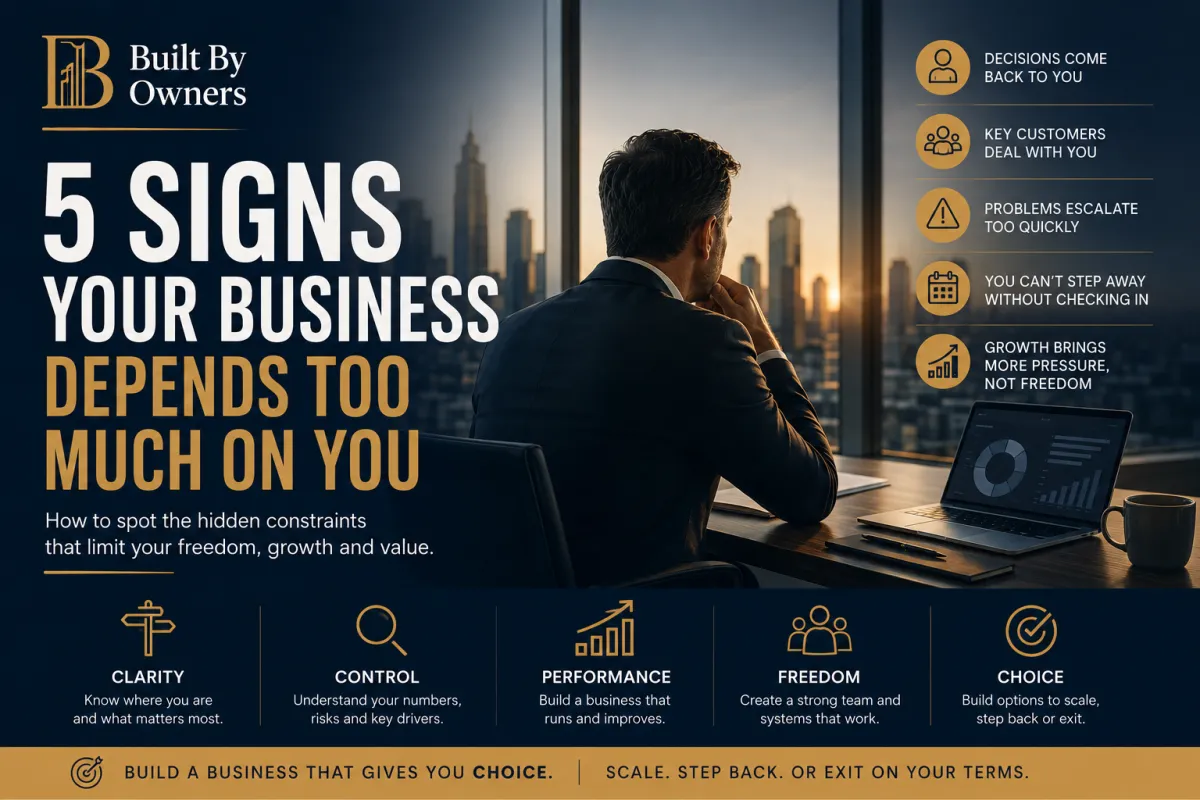
5 Signs Your Business Depends Too Much on You
Most business owners do not realise how dependent the business is on them until they try to step away.
Not permanently.
Just for a holiday.
A few days out of the office.
A week without checking in.
A period where the team has to make decisions without them.
That is often when the truth appears.
The business may be successful.
It may have customers, staff, revenue, profit and momentum.
But if everything still comes back to the owner, there is a hidden constraint inside the business.
That constraint affects more than the owner’s time.
It affects growth.
It affects value.
It affects succession.
It affects saleability.
It affects the owner’s ability to choose what happens next.
At Built By Owners, we call this owner dependency.
And it is one of the biggest issues inside many established owner-managed businesses.
The good news is that owner dependency can be reduced.
But first, you have to see it clearly.
Here are five signs your business may still depend too much on you.
1. Most important decisions still come back to you
This is one of the clearest signs.
The business may have a team.
It may have managers.
It may have experienced people.
But when something important happens, the decision still comes back to the owner.
A customer issue.
A pricing decision.
A supplier problem.
A staffing question.
A delivery challenge.
A difficult commercial call.
The team may be capable, but they still look to the owner for approval, reassurance or final judgement.
At first, this can feel normal.
After all, the owner built the business. They know the history. They understand the customers. They have the experience.
But over time, this creates a bottleneck.
Decisions slow down.
People stop taking ownership.
The owner becomes the default escalation point.
The business cannot move at pace without them.
This is why decision ownership matters.
If every meaningful decision still depends on the owner, the business is not yet independent.
The question to ask is simple:
What decisions could the team make without me — and what decisions still wait for me?
That answer will show you where the dependency sits.
2. Key customers still expect to deal with you personally
Many owners are proud of their customer relationships.
And they should be.
In the early years, those relationships often helped build the business. The owner won the trust, protected the standards and created the reputation.
But there is a risk.
If the customer relationship sits with the owner rather than the business, value becomes fragile.
A buyer will notice this.
A successor will notice this.
A senior manager will feel it.
And the owner will experience it every time a key customer insists on speaking to them directly.
This does not mean the owner should have no customer relationships.
But it does mean the business needs a way to transfer trust from the owner to the company.
That requires structure.
Clear account ownership.
Consistent service standards.
Shared customer knowledge.
Documented expectations.
A team that customers trust.
Because if the owner is still the main reason customers stay, the business carries more risk than it should.
The question to ask is:
If I stepped back, would our key customers still feel properly looked after?
If the answer is uncertain, there is work to do.
3. Problems escalate to you too quickly
Every business has problems.
That is not the issue.
The issue is where those problems go.
In owner-dependent businesses, problems move upwards very quickly.
A delivery issue becomes the owner’s issue.
A staff problem becomes the owner’s issue.
A customer complaint becomes the owner’s issue.
A cash flow concern becomes the owner’s issue.
A decision delay becomes the owner’s issue.
The team may be working hard, but the owner becomes the pressure valve.
This creates a pattern.
The business functions, but only because the owner keeps absorbing the complexity.
That is not sustainable.
It also prevents people from growing.
If the owner always solves the problem, the team never fully develops the confidence, judgement or accountability to solve more themselves.
Reducing dependency does not mean abandoning the team.
It means creating clear rules, responsibilities and decision boundaries so people know what they can resolve, what they should escalate, and how they are expected to think.
The question to ask is:
Are people escalating because they genuinely need me, or because the business has trained them to wait for me?
That distinction matters.
4. You cannot step away without checking in
This is the practical test.
Can you step away from the business without disruption?
Not just physically leave the building.
Can you mentally step away?
Can you take a proper break without checking messages?
Can you go on holiday without being pulled into decisions?
Can the team handle routine issues without you?
Can customers be served properly without your involvement?
Can performance continue without your daily attention?
If not, the business may be successful, but it is not yet independent.
A business that needs the owner every day gives the owner very little real freedom.
This is one of the central ideas behind Built By Owners: the business should serve the owner, not trap them.
Owner independence does not happen by accident.
It is built through clarity, control, systems, leadership and accountability.
The question to ask is:
If I took 30 days away from the business, what would break, slow down or quietly wait until I returned?
That answer is one of the most useful diagnostics an owner can run.
5. Growth has increased pressure, not freedom
Growth is often seen as the answer.
More sales.
More customers.
More staff.
More turnover.
More opportunity.
But growth without structure can create a bigger problem.
If the business is owner-dependent at £500,000 turnover, it may still be owner-dependent at £2 million.
The only difference is that the pressure is greater.
More people need decisions.
More customers need attention.
More delivery needs managing.
More cash moves through the business.
More complexity appears.
The business gets bigger, but the owner’s role does not properly change.
This is why growth alone is not enough.
Before you grow the business, you need to understand it better.
Where is profit really made?
Where is margin being lost?
Where are the bottlenecks?
Where are the risks?
Where does the owner still carry too much responsibility?
A stronger business is not just bigger.
It is clearer, more controlled, more profitable, more structured and less dependent on the owner.
The question to ask is:
Has growth made the business easier to run — or has it simply made my job bigger?
If growth has increased pressure rather than freedom, the business needs to be built differently.
Owner dependency is not a failure
This is important.
Owner dependency does not mean the owner has done something wrong.
In many cases, the business depends on the owner because the owner cared enough to build it, protect it and hold it together.
That is often what gets the business to where it is today.
But what gets a business to one stage can limit it at the next.
In the early days, the owner being central may be necessary.
Later, it becomes a constraint.
The shift is not about the owner becoming less important.
It is about the owner becoming important in a different way.
Less operator.
More leader.
Less firefighter.
More architect.
Less central to every detail.
More focused on direction, performance and value.
That is the shift from running the business to building the business.
What to do next
If these signs feel familiar, the answer is not to work harder.
Most owners are already working hard.
The answer is to build more structure around the business.
Start with clarity.
What do you actually want the business to give you over the next three years?
Then look at control.
Do you understand the real numbers, margins, cash flow, risks and drivers?
Then look at performance.
Are the key parts of the business repeatable, measurable and improving?
Then look at leadership.
Can decisions move away from you without quality dropping?
Then look at choice.
What options would the business give you if it were less dependent on you?
This is the thinking behind the B.U.I.L.D. Framework:
Blueprint — clarity
Understand — control
Improve — performance
Lead — freedom
Decide — choice
You do not skip stages.
You build through them.
Final thought
A business that depends on the owner is not automatically a bad business.
It may be profitable.
It may be respected.
It may have loyal customers.
It may have a strong team.
It may have real potential.
But if everything still comes back to the owner, that business is not yet as strong, scalable or valuable as it could be.
The real test is not simply whether the business works when you are there.
The real test is whether it can continue to perform when you are not.
That is where freedom begins.
That is where value improves.
And that is where the owner gains real choice.
Want to understand how dependent your business really is on you?
You do not need to sell tomorrow.
But you do need to know whether your business could survive, perform and be valued without you at the centre of everything.
Built By Owners helps established business owners reduce dependency, strengthen profitability and build companies that give them real choice — including the option to scale, step back or exit on their terms.
Start by understanding where your business stands today.
Take the Built By Owners Scorecard: