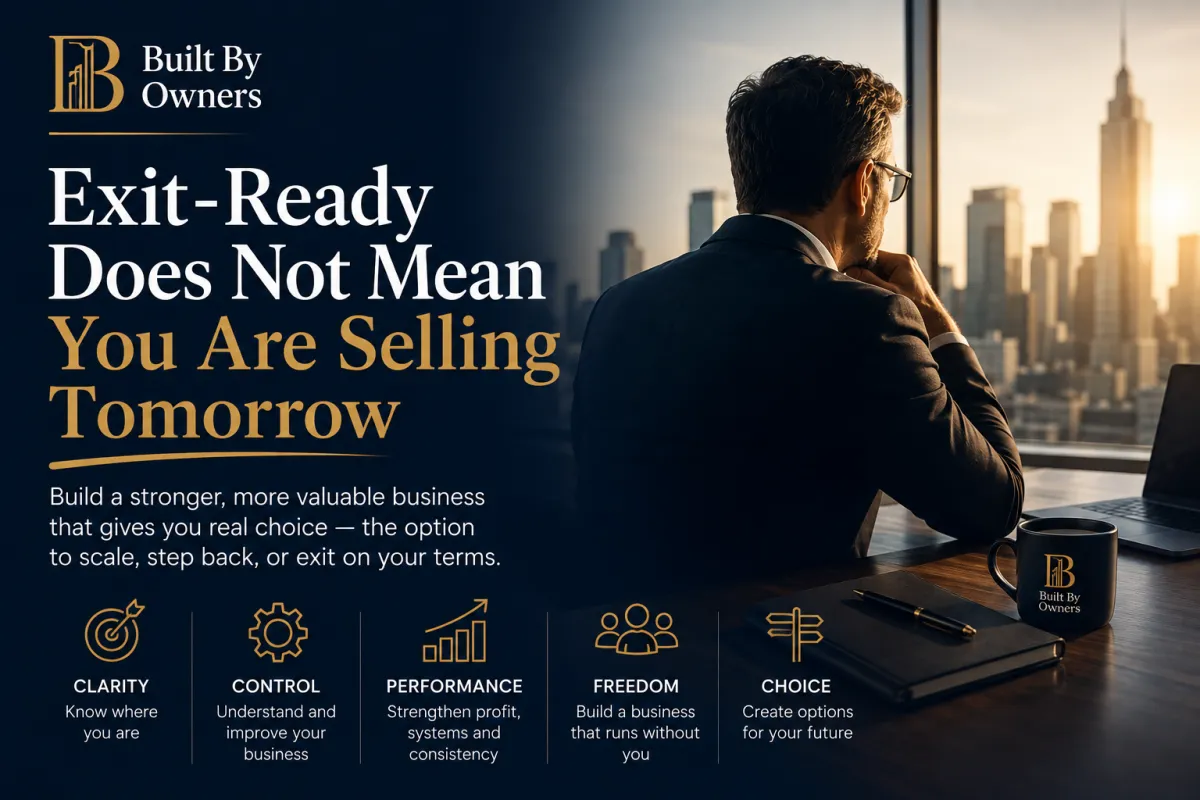
Exit-Ready Does Not Mean You Are Selling Tomorrow
Many business owners resist the phrase “exit-ready”.
And I understand why.
For some, it sounds too final.
It sounds like selling.
It sounds like leaving.
It sounds like handing over control.
It sounds like the beginning of the end.
But that is not what exit-readiness really means.
Being exit-ready does not mean you are selling tomorrow.
It means you are building a business that gives you options.
A business that can grow without consuming you.
A business that can perform without everything relying on you.
A business that can attract confidence from buyers, partners, successors, lenders or senior leaders.
A business that gives you the freedom to decide what happens next.
That may be a full exit one day.
But it may also be scaling further, stepping back, bringing in management, passing the business on, taking investment, acquiring another business, or simply creating more freedom while keeping ownership.
The point is not to force a sale.
The point is to build from strength.
Most owners wait too long to think about exit
One of the biggest mistakes business owners make is waiting until they are tired, approached by a buyer, dealing with pressure, or ready to retire before they start thinking about exit.
By then, the business may not be ready.
The numbers may not be clear enough.
The management team may not be strong enough.
The systems may not be consistent enough.
The owner may still hold too many key relationships.
The business may still depend too heavily on one person.
And when that happens, choice becomes limited.
The owner may still be able to sell, but the deal may not be on the terms they hoped for.
They may have to stay involved longer than expected.
They may face a lower valuation.
They may be pushed into an earn-out.
They may discover that the business works well with them inside it, but looks riskier when viewed from the outside.
This is why exit-readiness matters.
Not because every owner should sell.
But because every owner should understand what their business would look like to someone else.
Exit-readiness is really business-readiness
A business that is exit-ready is usually a better business to own.
That is the part many owners miss.
The same things that make a business more attractive to a buyer also make it stronger for the current owner.
Clear numbers.
Reliable profit.
Reduced dependency on the owner.
Strong leadership.
Repeatable systems.
Consistent sales process.
Better reporting.
Less reliance on one customer, one employee or one relationship.
Those things matter whether you sell or not.
They make the business easier to run.
They make decisions clearer.
They reduce pressure on the owner.
They increase confidence.
They improve value.
So exit-readiness is not just about the transaction at the end.
It is about the quality of the business today.
At Built By Owners, we describe the goal as building a stronger, more profitable business that gives the owner real choice, including the option to scale, step back, or exit on their terms.
That word matters: option.
Not obligation.
A business should give you choice, not trap you
Many owners start businesses for freedom.
Freedom to make decisions.
Freedom to create something of their own.
Freedom to build wealth.
Freedom to shape their future.
But somewhere along the way, the business can become the thing that removes freedom.
The owner becomes central to everything.
The team waits for decisions.
Customers expect the owner.
Problems escalate to the owner.
Sales depend on the owner.
Margins sit in the owner’s head.
The business cannot move properly without them.
At that point, the owner may own the shares, but the business owns their time.
This is where exit-readiness becomes useful.
Because an exit-ready business is not built around dependency.
It is built around clarity, control, performance, leadership and choice.
It can stand more independently.
And when a business stands more independently, the owner has more options.
The best time to build options is before you need them
Options are rarely created in the moment you need them.
They are built beforehand.
You do not create a strong management team the month before a sale.
You do not remove owner dependency after a buyer starts due diligence.
You do not fix unclear margins when someone is already questioning the numbers.
You do not build proper systems once the business is already under pressure.
You build those things early.
Before you have to act.
Before you are tired.
Before you are approached.
Before the market changes.
Before succession becomes urgent.
Before a buyer asks difficult questions.
That is why one of the strongest principles inside Built By Owners is this:
The best time to build options is before you need them.
Your own material puts it clearly: “Don’t wait until you have to act. Build readiness early. Decide from a position of strength.”
That is the real point of exit-readiness.
It gives the owner the ability to decide from strength rather than pressure.
What does an exit-ready business actually look like?
An exit-ready business is not perfect.
No business is.
But it is understandable, transferable and less dependent on the owner.
It has clear numbers.
The owner knows the real profit, the margins, the cost structure, the cash position and the drivers of performance.
It has clear direction.
The business is not just chasing opportunity. It is being built around the owner’s commercial and personal goals.
It has stronger performance.
Sales are not random. Delivery is not chaotic. Pricing is not guesswork. Growth is not dependent on heroic effort.
It has leadership depth.
The owner is not the only person who can make decisions, manage relationships or solve problems.
It has systems and structure.
Important work is done consistently, not differently depending on who happens to be involved.
And most importantly, it can continue to perform without the owner being involved in every detail.
That is what creates confidence.
For the owner.
For the team.
For a buyer.
For a successor.
For a partner.
For an investor.
Exit-readiness gives you more than one route
A business that is not ready usually has limited options.
The owner has to stay involved.
The business cannot scale without more pressure.
A buyer sees risk.
A successor feels exposed.
A partner may be cautious.
The team remains dependent.
But when the business is stronger, clearer and less owner-dependent, the owner has more routes available.
They can continue growing with structure.
They can step back while retaining ownership.
They can bring in a managing director or leadership team.
They can acquire another business.
They can bring in a strategic partner.
They can prepare for succession.
They can explore a partial sale.
They can consider a full exit.
This is why the final stage of the B.U.I.L.D. Framework is Decide.
Not “sell”.
Decide.
Because the outcome is strategic choice.
The Decide stage is about building real options, creating strategic flexibility and choosing what happens next.
That is a very different message from “you need to sell your business”.
It says: build a business strong enough that you are not forced into one path.
Why some owners avoid the conversation
Many owners avoid thinking about exit because it feels uncomfortable.
They may feel too young to think about it.
They may not want to appear disloyal to the business.
They may worry staff will misunderstand.
They may not know what the business is worth.
They may feel the business is not ready.
They may not want to face how dependent the business still is on them.
But avoiding the conversation does not remove the issue.
It simply delays it.
And often, delay makes the issue more expensive.
The better approach is not to ask, “Am I ready to sell?”
The better question is:
Am I building a business that gives me choice?
That question changes everything.
It moves the conversation away from exit as an event and towards readiness as a discipline.
The owner’s role has to evolve
If the business is going to become more valuable and less dependent, the owner’s role must change.
The owner cannot remain the main salesperson, problem-solver, decision-maker, delivery expert, relationship holder and escalation point forever.
At some stage, the owner has to move from doing to leading.
From operator to owner.
From reactive to strategic.
From central to scalable.
From being the business to building the business.
This is not easy.
Many owners are central because they care.
They have high standards.
They know the detail.
They do not want things to go wrong.
But if everything continues to run through the owner, the business remains constrained.
Your Built By Owners material says it well: “If everything runs through you, nothing moves fast.” It also states that freedom is built through leadership and that the owner must be removed as the bottleneck.
That is not just a lifestyle issue.
It is a value issue.
You do not need to sell tomorrow
This is the point worth repeating.
You do not need to sell tomorrow.
You may never sell.
You may choose to keep the business for years.
You may want it to fund your lifestyle.
You may want to pass it on.
You may want to grow through acquisition.
You may want to bring in leadership and step back.
You may want to take some money off the table but stay involved.
All of those are valid.
But the stronger the business, the more choice you have.
That is why exit-readiness matters even if you are not planning to exit.
Because the work that makes a business more saleable also makes it more scalable, more manageable and more valuable.
Build from strength, not pressure
The worst time to improve a business is when you are already under pressure.
The best time is when you still have time, energy and choice.
That is when you can make better decisions.
You can strengthen the numbers.
You can reduce dependency.
You can build leadership.
You can create systems.
You can improve profitability.
You can understand value.
You can decide what you want the business to become.
This is the difference between reacting and building.
Reacting happens when the decision is already upon you.
Building happens before that.
And owners who build properly give themselves more control over the future.
Final thought
Exit-ready does not mean finished.
It means prepared.
Prepared for growth.
Prepared for opportunity.
Prepared for succession.
Prepared for partnership.
Prepared for sale.
Prepared for the owner to have more freedom and more control.
A business that only works because the owner is constantly involved is fragile.
A business that can perform without the owner is stronger.
And whether you sell, scale, step back or keep going, strength gives you choice.
That is the real point.
Not exit for the sake of exit.
Readiness for the sake of freedom, value and control.
Because the best business is not just the one that keeps you busy.
It is the one that gives you options.
Build a business that gives you choice
You do not need to sell tomorrow.
But you do need to know whether your business could survive, perform, and be valued without you at the centre of everything.
Built By Owners helps established business owners reduce dependency, strengthen profitability, and build companies that give them real choice — including the option to scale, step back, or exit on their terms.
Start by understanding where your business stands today.
Take the Built By Owners Scorecard: